
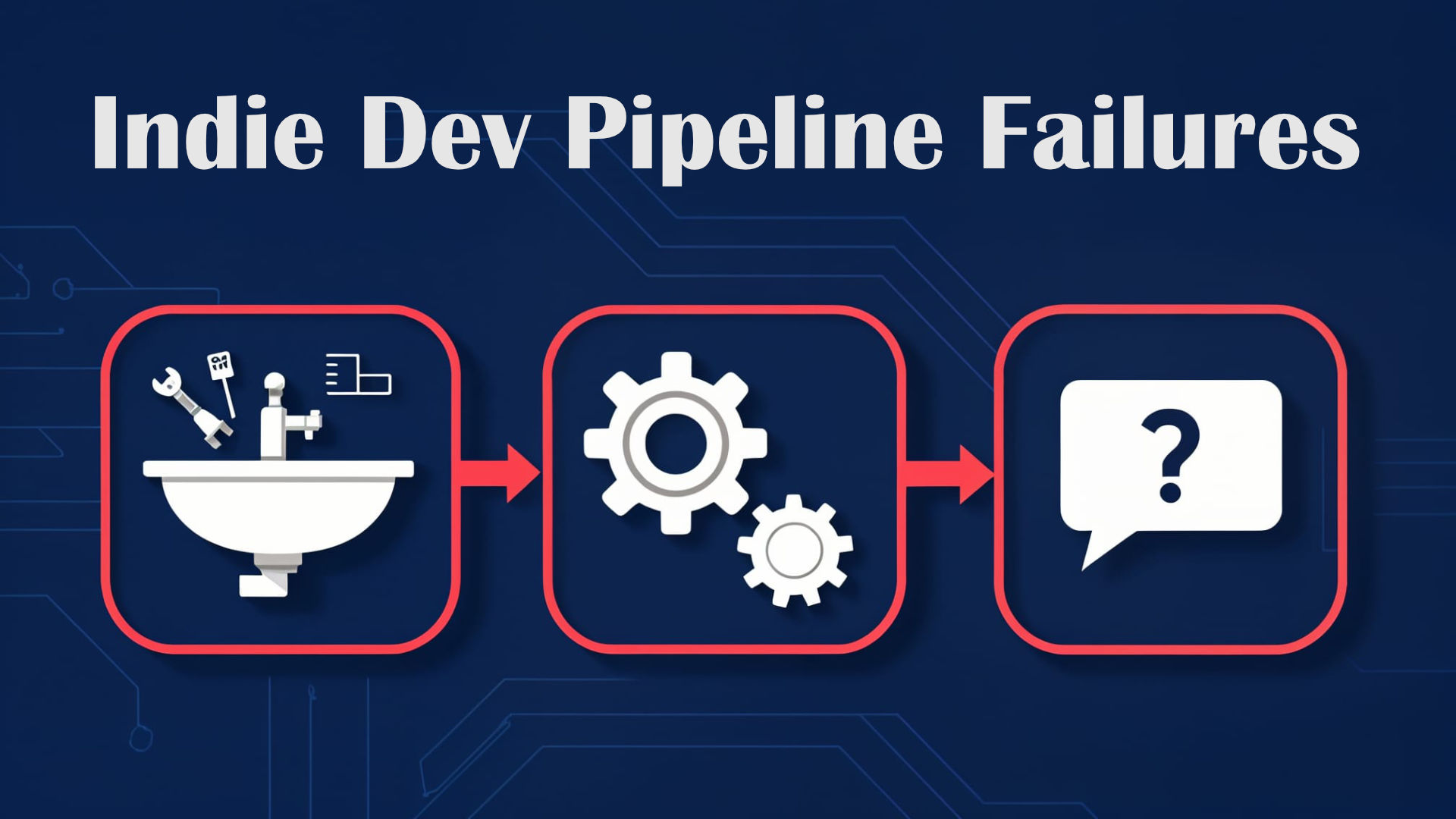
The 3 Non-Code Mistakes That Sink Indie Game Pipelines
Your code is clean. Your shaders are slick. The core gameplay loop? It hums. Yet, your project feels chaotic, progress is glacial, and the excitement has soured into a low-grade dread. You’re putting in the hours, but the finish line isn’t getting any closer.
After all, in 2026, the code often writes itself thanks to AI. The real bottleneck isn’t in your compiler. It’s human, systemic, and often invisible until it has already crippled your project.
These are the silent killers of indie game pipelines: strategic and organizational failures that no amount of clever code can fix. Today, we’re diagnosing the three most common and costly non-code mistakes.
Mistake #1: The ‘Kitchen Sink’ Roadmap (The Strategic Failure)
It starts with a spark. “This procedural dialogue system would be incredible,” you think. Then, “And if we add a relationship meter that affects the world state…” The feature list grows, each addition feeling essential. This is the moment a promising project becomes unmanageable.
This isn’t just creative enthusiasm; it’s a strategic business error disguised as a creative one. The failure lies in not ruthlessly distinguishing between the “shippable core” and the “nice-to-have context.” The core is the minimum set of features that delivers your game’s unique promise. Everything else is context that can – and often should – be saved for a version 1.1 or cut entirely.

The cost is quantifiable. I’ve worked with studios and individuals drowning in “kitchen sink” roadmaps. The result is almost universal; team burnout from endless, directionless work, blown budgets that strain personal finances, and the ultimate price: a failed launch or, more commonly, a game that simply never ships.
This mis-prioritization is the first fracture in a pipeline. The anxiety it creates in the form of feeling overwhelmed and behind schedule often leads developers to seek control in the wrong place, which brings us to the second mistake.
Mistake #2: Process Fetishization (The Procrastination Trap)
Feeling the pressure of a bloated scope, a common reaction is to “get organized.” You dive into researching the perfect project management tool. You spend days building a custom editor plugin to automate a task that would take minutes to do manually. You rebuild your asset pipeline for the third time.
This is the comforting illusion of “getting organized.” It feels intensely productive since it looks like you’re setting up the work, but it’s often a subtle, sophisticated form of procrastination. It’s the brain’s way of avoiding the hard, uncertain, and frankly scary creative work of actually doing the work: designing that tricky level, writing that dialogue, or solving that gnarly design problem.
The telltale signs are endless tool debates, over-engineered Jira workflows, and a preoccupation with “optimizing” before a single asset is finished. The root cause is a desire to avoid creative uncertainty.

The fix isn’t a better tool; it’s a mindset shift. Embrace “good enough” tools; Trello, Notion, or even a text file, and commit to iterative, messy progress. Build a vertical slice with duct tape and prayers, not a flawless factory that produces nothing. A working, ugly prototype is worth infinitely more than the blueprint for a perfect one.
But even with a focused scope and lean tools, a project can grind to a halt if its most vital resource, knowledge, is trapped. This is the third, and most insidious, failure.
Mistake #3: Institutional Amnesia: When Knowledge Has Nowhere to Live
Picture this: a key developer goes on vacation. A bug surfaces in their bespoke netcode. The team stares at the monolithic, undocumented script. Production stops for a week.
Alternatively, you, the solo developer, open your own six-month-old code and spend a day reverse-engineering “why did I do it this way?!”

This is Institutional Amnesia. For the solo dev, it’s “future you” having no access to “past you’s” reasoning. For a team, it’s “teammate B” having no clue about “teammate A’s” system. It’s the failure to institutionalize knowledge, creating single points of failure (a “Bus Factor” of 1) and guaranteeing massive, demoralizing rework.
The root cause is knowledge living only in people’s heads or lost in ephemeral Slack threads. This creates a vicious cycle:

The antidote isn’t more documentation; it’s smarter documentation. We need to stop asking, “How does this work?” and start answering, “Why is it built this way?”
I advise teams to start a simple Architectural Decision Log (ADL). It’s not a novel concept, but its power is in its constraints. For any significant system or crossroads, you make one entry in a shared doc. Just three things:
- What we decided. (e.g., “Use an event bus for UI communication.”)
- The context that forced the decision. (e.g., “Our UI was becoming a spaghetti-web of direct calls that broke every time we added a menu.”)
- The trade-offs we accepted. (e.g., “Adds some indirection, but makes adding new UI elements trivial and keeps systems decoupled.”)
This log isn’t a maintenance burden. It’s a time capsule for your past reasoning. When a new hire, a future you, or a stressed teammate encounters that event bus, they aren’t met with a silent monolith. They’re met with the story of its creation. It transforms “What idiot built this?!” into “Ah, I see the problem they were solving.”
Conclusion: The Syndrome and the Solution
These three problems – scope bloat, tool procrastination, and institutional amnesia – are not isolated issues. They are a syndrome that feeds on itself. An unfocused roadmap creates chaos, which makes you crave the false control of perfect tools. Poor knowledge-sharing makes every person a potential bottleneck, rendering even the best-laid plans fragile.
The fix for your pipeline isn’t finding a better engine or a smarter AI. It’s about building smarter, more resilient creative habits. It’s a shift from reacting to problems to designing a system that prevents them.
This is the work I do with indies. I start our productivity consulting engagements by diagnosing these exact pipeline fractures. Fixing them isn’t about writing better code; it’s about implementing the right creative and production safeguards. My first step with a new studio partner is to audit for these exact patterns, because building a sustainable, repeatable practice is the true foundation of not just starting your game, but actually finishing it.
The path to a smoother pipeline begins by looking up from the code editor. What’s the one “non-code” problem causing the most friction in your project right now?