
I Ran a Game Pitch Workshop. Here’s The One Thing Every Single Attendee Struggled With.
A few weeks back, I hosted an intimate workshop for a small group of indie developers focused on pitching their games. The size of the group turned out to be its greatest strength. In that focused setting, a pattern emerged so clear, so universal, it became the entire lesson of the day.
It wasn’t structuring a deck. It wasn’t managing their nerves.
It was defining the “Why” for a specific human being in the room.
Let me explain. Everyone could tell me what their game was. “It’s a rogue-like metroidvania with a crafting system based on musical notes.” Great. Visual. Interesting.
Everyone could, with a little nudging, tell me who it was for. “It’s for players who love exploration and deep systemic play.” Good. A start.
But when I asked, “Why should that publisher, sitting across from you at GDC, or that investor, reading your email at 11 PM, care about your game specifically?” – the room went quiet. The confident descriptions of mechanics faltered.
The struggle wasn’t a lack of passion. Their passion was overflowing. The struggle was translating that passion into a compelling reason for a stranger to invest their time, money, or reputation.
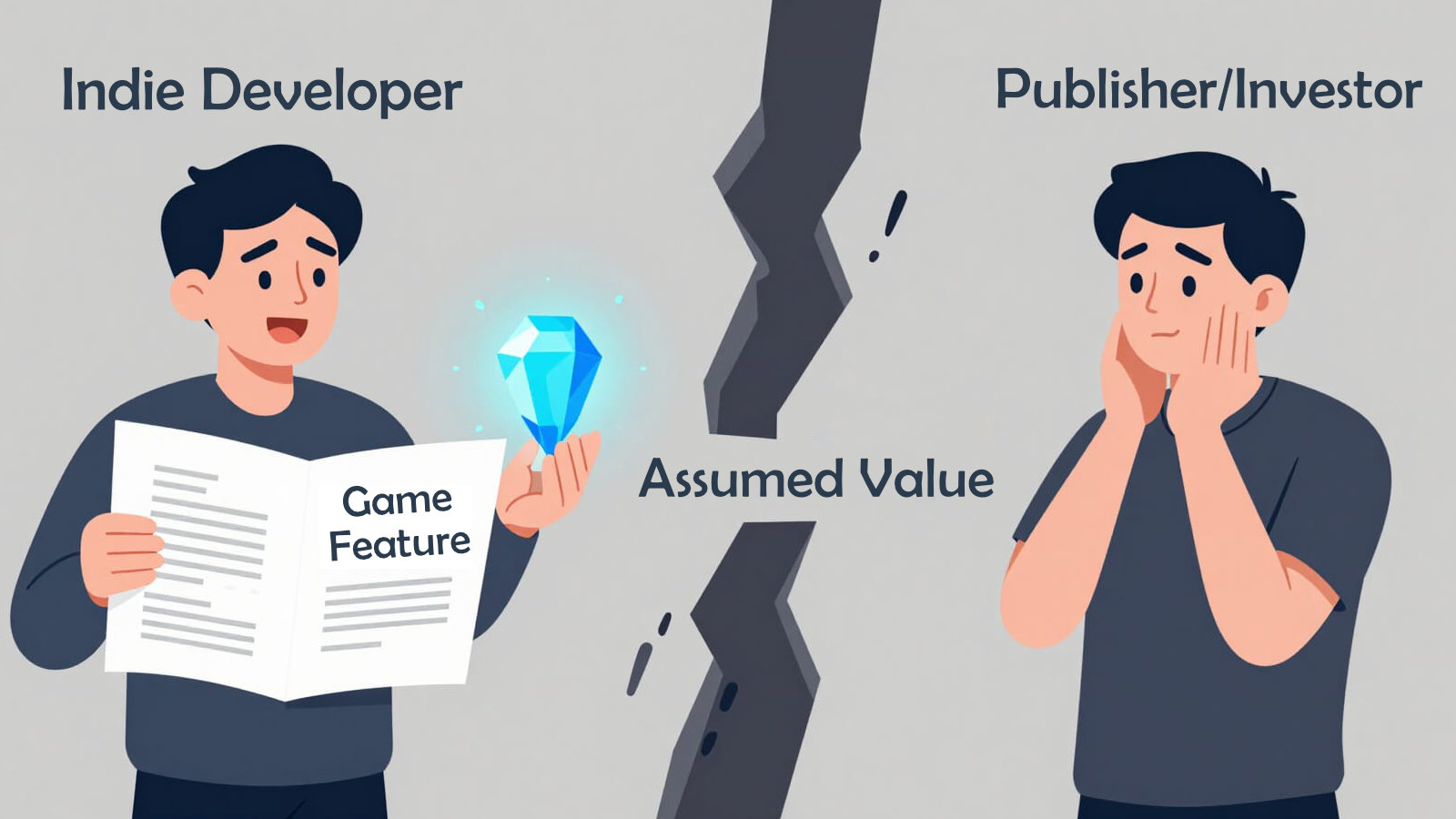
We’d all get tangled in what I’ve started calling “The Developer’s Trap.” We talk about features (our “what”) assuming the value is self-evident. We believe that because we are excited by our novel inventory system, the listener will be too. We pitch the solution without first making the listener feel the problem or share the dream.
In the workshop, we turned this around with a brutally simple exercise. We banned the words “mechanic,” and “feature” for five minutes.
Instead, we started with the human on the other side of the table. We asked:
- What keeps them up at night? (Is it finding the next Vampire Survivors for a quick ROI, or a narrative masterpiece for their portfolio?)
- What does success look like for them in six months?
- How does your project become a piece of their puzzle?
Suddenly, the pitch wasn’t a presentation. It was the opening move in a potential partnership. The “musical note crafting system” wasn’t just a cool idea; it was the unique signature that could make the game marketable in a crowded genre, or the key hook for a specific segment of players that publisher is trying to reach.
The shift in the room was palpable. The anxiety of “am I doing this right?” was replaced by the focused energy of “how do I connect?”
So, if you’re struggling with your pitch, don’t start with your slides. Start with a blank page. Write down not what your game is, but why it matters to the one person you most need to convince. Everything else; the deck, the trailer, the one-liner flows from that single point of connection.
It’s the hardest part of the pitch. Because it’s not about your game. It’s about them. And that, it turns out, is the only thing that truly cuts through the noise.
Was this helpful? Also, what do you think is the hardest part of translating your passion for a project into a pitch for a stranger?
If you’re interested in refining your pitching skills and gaining more control over your delivery, I encourage you to look into public speaking techniques tailored for pitch environments. And for those looking for a hands-on experience, my interactive workshops are designed to help indie developers build these essential skills.